Ask most UK gardeners what their garden looks like in January and the answer is usually the same — bare, brown, depressing and best ignored until March. The lawn is muddy, the borders are empty and the whole thing looks like it is waiting for something to happen.
But it absolutely does not have to be this way.
With the right plants a UK garden can be genuinely beautiful in the depths of winter — fragrant flowers on bare branches, vivid coloured stems glowing in the low winter light, bold evergreen foliage providing structure and colour, and the first brave bulbs pushing through the frozen ground before anyone expects them.
Winter is actually one of the most rewarding seasons to garden for — precisely because so few people bother. A single flowering shrub in a bare January border makes ten times the impact of one flower among dozens in June. The competition is simply not there.
This guide introduces you to twelve outstanding plants that genuinely earn their place in a UK garden through the darkest months of the year.
Why winter planting is worth the effort
Before we dive into the plants themselves it is worth understanding why winter interest is so valuable — and so underrated.
Your garden is most visible in winter. In summer borders are full and lush — it is easy to make a garden look good. In winter the garden is stripped back and every plant that is performing really counts. Visitors notice a beautiful winter garden far more than they notice a beautiful summer one — because they are not expecting it.
Winter plants are often the most fragrant. Some of the most intensely scented plants in existence flower in winter — witch hazel, sarcococca, daphne, viburnum. They have evolved to produce powerful fragrance to attract the few pollinators around in cold weather. Walking past a sarcococca in January and being stopped in your tracks by its extraordinary sweetness is one of the great pleasures of winter gardening.
Winter plants are low maintenance. Most winter performing plants are tough, established woody shrubs or bulbs that look after themselves. There is very little to do — which suits the season perfectly.
They make your garden usable all year. A garden that looks beautiful in winter is a garden you actually want to spend time in — looking out of the window on a grey January morning and seeing something beautiful rather than something depressing genuinely improves your wellbeing.
The 12 best plants for winter interest in a UK garden
1. Hellebore (Helleborus orientalis)
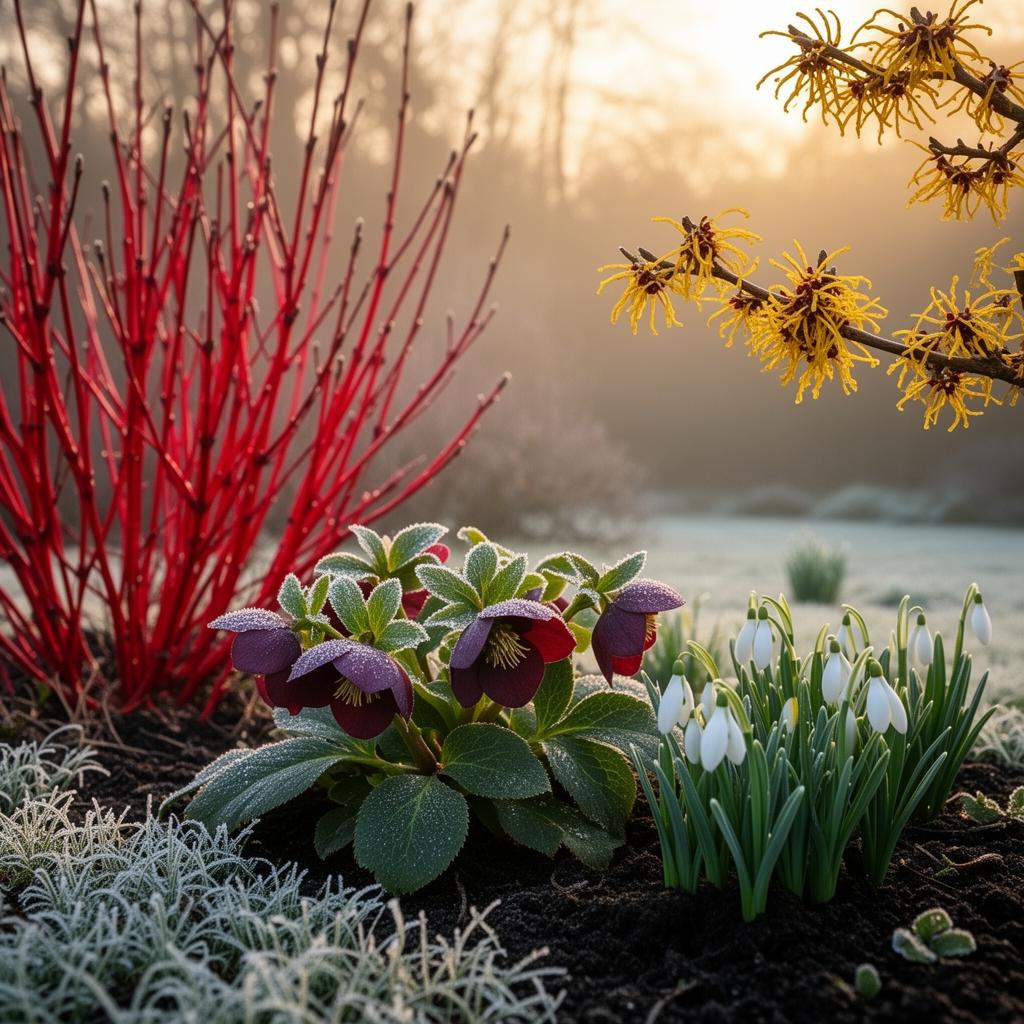
If you could only choose one plant for winter interest in a UK garden it would have to be the hellebore. Nodding flowers in extraordinary colours — deep plum, pale pink, creamy white, soft yellow and near-black — appear from January through to March, often pushing through snow without a care in the world.
Hellebores thrive in partial shade and are completely low maintenance. They are evergreen so the bold dark foliage provides structure all year. Cut the old leaves back to the ground in January and the flowers show off beautifully. Once established they self-seed gently to gradually colonise a shady border.
Best for: shady borders, woodland gardens, under deciduous trees. Flowers January to March. Maintenance very low.
2. Winter heather (Erica carnea)
While summer heathers need acid soil, winter heather — Erica carnea — is one of the most accommodating plants available. It tolerates lime soil, clay soil, poor soil and almost any conditions you care to throw at it. In return it gives you a carpet of tiny flowers from December right through to March in pink, purple, white and cerise.
Plant several together for a weed-suppressing carpet of winter colour. The foliage is evergreen and looks attractive even when not in flower. Completely hardy throughout the UK including Scotland.
Best for: front of borders, rockeries, containers, ground cover. Flowers December to March. Maintenance very low.
3. Snowdrop (Galanthus nivalis)
Few sights in the natural world are as uplifting as the first snowdrops of the year pushing through cold bare soil in January. These tiny bulbs are completely indestructible — they flower through frost, snow and ice without any concern whatsoever.
Buy snowdrops in the green — as growing plants rather than dry bulbs — for the most reliable results. Plant them under deciduous trees or shrubs where they will naturalise over time into increasingly impressive drifts. Once established they spread year on year without any attention at all.
Best for: naturalising under trees, woodland gardens, front of borders. Flowers January to February. Maintenance none once established.
4. Winter aconite (Eranthis hyemalis)
The winter aconite is one of the earliest flowering plants in the entire garden calendar — bright cheerful yellow flowers appearing from January onwards, often before the snowdrops. The flowers are surrounded by a ruff of bright green leaves that make them look like tiny suns pushing through the cold ground.
Like snowdrops they naturalise beautifully under deciduous trees and shrubs. Plant tubers in autumn or buy growing plants for the most reliable establishment. Combines beautifully with snowdrops for a classic late winter display.
Best for: naturalising under trees, rockeries, front of borders. Flowers January to February. Maintenance none once established.
5. Witch hazel (Hamamelis x intermedia)
One of the most spectacular winter flowering shrubs available anywhere in the world. Witch hazel produces spidery ribbon-like flowers in yellow, orange, copper and red on completely bare branches from December through to February — and the fragrance is extraordinary. On a cold still winter morning the scent of a mature witch hazel carries across the whole garden.
Witch hazel is slow growing but completely worth the wait. It also provides brilliant autumn leaf colour before it drops its leaves and bursts into flower. Plant in a prominent position where you can appreciate both the flowers and the fragrance.
Best for: specimen shrub, woodland gardens, near paths where fragrance can be enjoyed. Flowers December to February. Maintenance low — no regular pruning needed.
6. Sarcococca (Sarcococca confusa)
Also known as Christmas Box and arguably the most intensely fragrant small shrub available in any season let alone winter. Sarcococca produces tiny white flowers from December through to February — they are almost invisible but the fragrance they produce is extraordinary. Sweet, warm and penetrating — it stops you in your tracks.
Sarcococca is also one of the most useful plants for difficult spots. It thrives in deep dry shade under trees where almost nothing else will grow. Completely evergreen, fully hardy throughout the UK and completely low maintenance. If you have a dark corner that needs year-round interest and winter fragrance this is your plant.
Best for: deep shade, dry conditions under trees, near doorways and paths. Flowers December to February. Maintenance very low.
7. Viburnum (Viburnum x bodnantense 'Dawn')
A large winter flowering shrub that earns its space in any garden many times over. Viburnum 'Dawn' produces clusters of pink and white flowers on bare stems from November right through to March — and the fragrance is remarkable. One of the most reliably spectacular winter shrubs available for UK gardens.
'Dawn' grows to around two to three metres tall and wide so needs some space — but if you have room it is an outstanding choice. The bare stems covered in blossom on a grey winter day is one of the most beautiful sights a British garden can offer.
Best for: back of borders, specimen shrub, large gardens. Flowers November to March. Maintenance low.
8. Dogwood (Cornus alba 'Sibirica')
Grown not for flowers but for the most vivid and spectacular coloured stems imaginable. From November through to March the bare red stems of dogwood glow like fire in the winter garden — catching the low winter sun and illuminating even the dullest grey day.
The secret to the best stem colour is simple — cut the whole plant hard back to the ground each spring. It regrows vigorously through summer and the new young stems produced have the most vivid colour. Thrives in moist clay soil and is completely hardy throughout the UK.
Also available in yellow-stemmed (Cornus sericea 'Flaviramea') and orange-stemmed varieties. Plant two or three different colours together for a stunning winter display.
Best for: moist borders, clay soil, near water, winter stem colour. Interest November to March. Maintenance low — cut back once a year in spring.
9. Cyclamen (Cyclamen coum)
While Cyclamen hederifolium flowers in autumn, its close relative Cyclamen coum takes over in late winter — producing delicate pink, magenta and white flowers from January through to March. The flowers are accompanied by beautifully patterned silver and green marbled leaves that look attractive from autumn right through to late spring.
Both species together give you cyclamen interest from September all the way through to April — an extraordinary six month season from two small and completely undemanding plants. Both naturalise beautifully in dry shade under trees where little else will grow.
Best for: dry shade, under trees, woodland gardens. Flowers January to March. Maintenance none once established.
10. Mahonia (Mahonia x media 'Charity')
A bold architectural evergreen shrub. Mahonia produces long spikes of fragrant yellow flowers from November through to February. The large pinnate leaves look dramatic all year round — architectural and structural in a way few other shrubs can match. The flowers are followed by blue-black berries that birds love.
Mahonia thrives in shade and dry conditions — making it invaluable for those difficult spots under trees or against north-facing walls. Completely hardy throughout the UK. One of the most architectural and useful plants available for year-round structure and winter interest.
Best for: shade, dry conditions, north-facing aspects, architectural interest. Flowers November to February. Maintenance very low.
11. Winter jasmine (Jasminum nudiflorum)
Bright cheerful yellow flowers on bare green stems from November right through to February. Unlike summer jasmine winter jasmine has no fragrance — but the vivid yellow flowers on a grey winter day are cheerful and uplifting. One of the toughest and most reliable winter flowering wall shrubs available.
Winter jasmine is particularly valuable because it performs perfectly on north and east-facing walls — aspects where most flowering plants struggle. It is completely hardy, thrives on neglect and asks for almost nothing in return for months of winter colour.
Best for: north and east-facing walls, difficult aspects, trained against fences. Flowers November to February. Maintenance very low.
12. Garrya (Garrya elliptica 'James Roof')
The most dramatic of all winter interest plants — garrya produces long silvery-grey catkins hanging from the branches in January and February, sometimes reaching an extraordinary thirty centimetres in length. Against a dark evergreen background the effect is genuinely spectacular.
Garrya is an evergreen shrub that performs best against a wall — particularly a north or west-facing wall where many other plants would struggle. 'James Roof' is the best variety with the longest most dramatic catkins. Completely low maintenance and fully hardy throughout the UK.
Best for: north and west-facing walls, evergreen structure, dramatic winter display. Interest January to February. Maintenance very low.
Putting it all together — a winter garden plan
Here is how these twelve plants work together to give you something beautiful happening every single week from November through to March.
| Month | Plants performing |
|---|---|
| November | Viburnum 'Dawn', winter jasmine, mahonia, dogwood stems beginning |
| December | Viburnum, winter jasmine, mahonia, sarcococca, winter heather, witch hazel beginning |
| January | Snowdrops, winter aconite, hellebore, witch hazel, sarcococca, garrya catkins, dogwood stems, Cyclamen coum |
| February | Snowdrops, hellebore, winter aconite, witch hazel, Cyclamen coum, garrya, winter heather, viburnum still going |
| March | Hellebore, winter heather, Cyclamen coum finishing, early spring bulbs beginning |
Five months of genuine beauty. All from plants that are low maintenance, completely hardy and available from any good UK plant retailer.
Tips for getting the most from winter plants
Position fragrant plants near paths and doorways. The whole point of the extraordinary fragrance of sarcococca, witch hazel and viburnum is to be able to enjoy it. Plant them where you walk past regularly — near the front door, beside a path or close to where you park the car.
Use evergreens for structure. Winter is when the structural bones of your garden are most visible. Evergreen plants — hellebores, mahonia, sarcococca, garrya, winter heather — provide the framework that makes everything else look intentional rather than bare.
Think about the winter light. The low winter sun creates beautiful light effects that are completely different from summer. Dogwood stems glow like fire in low winter sunshine. Garrya catkins shimmer. Position these plants where the winter sun will hit them for maximum effect.
Plant in groups. A single snowdrop is charming. A hundred snowdrops naturalised under a tree is breathtaking. Most winter plants benefit enormously from being planted in generous numbers.
Layer your planting. Combine plants with different types of interest — the tall architectural structure of mahonia at the back, the mid-height fragrance of sarcococca and viburnum in the middle, the ground-level carpet of snowdrops, cyclamen and winter heather at the front. This layered approach creates a winter border that looks full and intentional rather than sparse.
Your winter garden starts with the right plan
Knowing which winter plants exist is just the beginning. The real magic happens when you choose the right ones for your specific garden — your soil type, your light conditions, your space and your taste.
A shady north-facing garden needs completely different winter plants to a sunny south-facing one. A small town garden needs different plants to a large country garden. What works beautifully in a sheltered southern garden may struggle in an exposed northern one.
That is exactly what GardenColourPlan is for. Answer eight simple questions about your garden and we will give you a personalised planting plan with exactly the right plants for your specific conditions — including the best winter performers for your soil, your aspect and your location. You can also browse the full plant library to explore every plant in our collection.
New here? Visit the Garden Colour Plan home page to see how it all works.